Wednesday, April 11, 2012

NAMIB-NAKULUFT NATIONAL PARK TO SWAKOPMUND


More desert as we go into Namib-Naukluft National Park, the largest game park in Africa.  It is hyper arid, with little rain, but the wind brings in mist from the Atlantic Ocean.  There are huge orange colored sand dunes, which are very old and the largest in the world.  The sharp edge always points north/south, since the winds are east/west.  That helps a little if you get lost.  A compass won't work here because there is a lot of iron oxide in the sand.  We stopped to climb Dune 45.  I only got about a third of the way up, since it is really difficult to climb up sand.  A young girl had fainted, so I stopped to help her down to her car.  That was my excuse.


Dune 45
Dune 45 attempt soon aborted


Sossusvlei is a vast clay pan in the central Namib Desert, which is surrounded by dunes.  We also visited Sesriem Canyon, formed by the Tsauchab River.
Sesriem Canyon


We stayed two nights at Hammerstein Lodge.  They rooms were OK but the pool was so dirty you couldn't see the rungs on the ladder.  They had pet cheetahs and leopards in huge cages that we could see.  We couldn't pet the leopard, but the cheetahs were amenable.  They had a pet Springbok running around who seemed to like to plant his horns in people's behinds.

Springbok
Spanish and Portuguese friends


Unusual to see an African recycling center
Our Nomad truck stops for lunch


We stopped at a farm for a "nature walk," which actually was a drive in a safari vehicle due to the high grass and presence of snakes.  The guide, Franz, showed us a calendar picture of how the area normally looks--just orange dirt--and we could compare it to the same view at present.  It is lush and green, but he says that is an aberration.  Normally it is too dry to grow anything.  For awhile, people were raising Corcoran(sp?) sheep.  They have to kill them at 8 days old to get the curly haired wool, because by the time they are one month old it is straight.  PETA had a campaign against this in the 1970's, so the sheep are all gone now.  The guide explained how some insects and animals survive in the desert.


Karakul sheep skin


Franz

We stopped for a break at the small town of Solitaire, which boasts a fantastic Swiss bakery with great apple pie.


The baker
The shopkeeper


We passed the Tropic of Capricorn and finally reached Swakopmund, the adventure capital of Namibia and the main harbor for German Southwest Africa.  The architecture shows a lot of Bavarian influence.  We also visited Walvis Bay, 33 km south, which was a British possession.  There were supposed to be flamingos here, but seem to have gone on their annual migration.


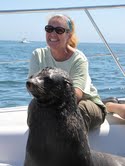
I took a dolphin cruise.  They were a little hard to spot due to high waves, but I did see lots of sea lions and pelicans, and they came right onto the boat to visit.  They are wild, but seem to be used to tourists.  The ocean cruise was a nice change after a week of desert.


Hundreds of seals


Sunday, April 8, 2012

KOKERBOOM FOREST


Day 4 I am back on lomotil.  We had a long drive to the edge of the Kalahari Desert.  We saw kudus and ostriches running.  We saw a pencil bush, which has a white milky sap the Bushmen used for poison arrows.  We visited a Kokerboom or Quiver tree forest.  The Bushmen use the hollowed out branches for quivers for their arrows.  Sociable Weaver birds build huge nests in the branches and keep on building until the nest falls down.  We saw about 200 of them around one huge nest.  The trees look similar to Joshua Trees in the California desert.  Nearby is the Giant's Playground, which looks like giants were tossing huge boulders all around the area.


Pencil Bush

Sociable Weaver nest

Quiver tree forest

Giant's Playground

On the road


Day 5 was Easter Sunday.  Some people went on an early game drive, which sounds wierd in the Kalahari Desert, but they did see giraffes and mongeese.  This was the first breakfast on the trip that I actually was able to eat, so I just relaxed and enjoyed it.

Saturday, April 7, 2012

FISH RIVER CANYON


We didn't start till 10 a.m., which gave me a chance to get through the rebound from the Immodium the day before.  We continued on through hours of desert landscape.  At one point, we passed through what seemed like miles of grapevines on each side of the road, which the guide told us is the largest vineyard owned by one person.  It is irrigated by the Orange River, with desert all around it.  Immediately after that was the worker housing, small mean huts that went on for at least another mile.  The road continues on to the government owned diamond mine, where loiterers are reportedly shot on sight.  We turned onto the road through Ai-Ais National Park.  We didn't see any animals in the desert landscape, though there are supposed to be lots of Springbok antelopes.  We continued on for a few more hours of desert before coming to the main gate for the National Park and Ai-Ais Hot Springs Spa resort.  This has lovely marble rooms and thermal baths.


Worker huts


Fish River Canyon

Sangria time!

Sunset at Fish River Canyon


On our drive today, we did see spingbok and ostriches.  We ventured to the Fish River Canyon, the largest in the world next to the Grand Canyon in Arizona, but not nearly so pretty because it does not have the colorful rock.  The temperatures here range from 2 to 50 degrees centigrade, although it is just a little hot now.  Christine from Spain made us Sangria to drink while we watched the sun go down.

Friday, April 6, 2012

TO NAMIBIA

April 4, ready to leave Capetown, the end of the continent, and start the journey back to my former world.  I purposely made it a challenging journey so there would not be an abrupt landing in LaLa Land since Capetown shares many decadent things with that region.  I will be going overland through Namibia and Botswana.

I met my new travel companions at the Nomad office in Greenmarket Square, Capetown.  Besides me, there are five Germans, a Spaniard, and a Brazilian.  Only one male, and he is married to one of the German girls.  Our crew includes Dingy, the driver,  Gertrude, the guide, and Ivan, the trainee.  The first two are Zimbabweans and Ivan is from Namibia.  

Our first day we began with a shopping trip to a local mall to get money and supplies, then Table View for a last chance look at Table Mountain.  We visited Kwa Itu and went in a farm wagon with our Bushman guides to learn about their lives in the coastal desert, including how they track and trap animals, where they live, how they dance, and what they eat.  My stomach has been a little upset since I ate lunch at a Kurdish restaurant the day before, so I passed on the traditional African lunch.

Bushman guide shows different animal tracks

Stone painting, apparently not ancient

Going in the farm wagon saved us a hot walk


Org Derac winery
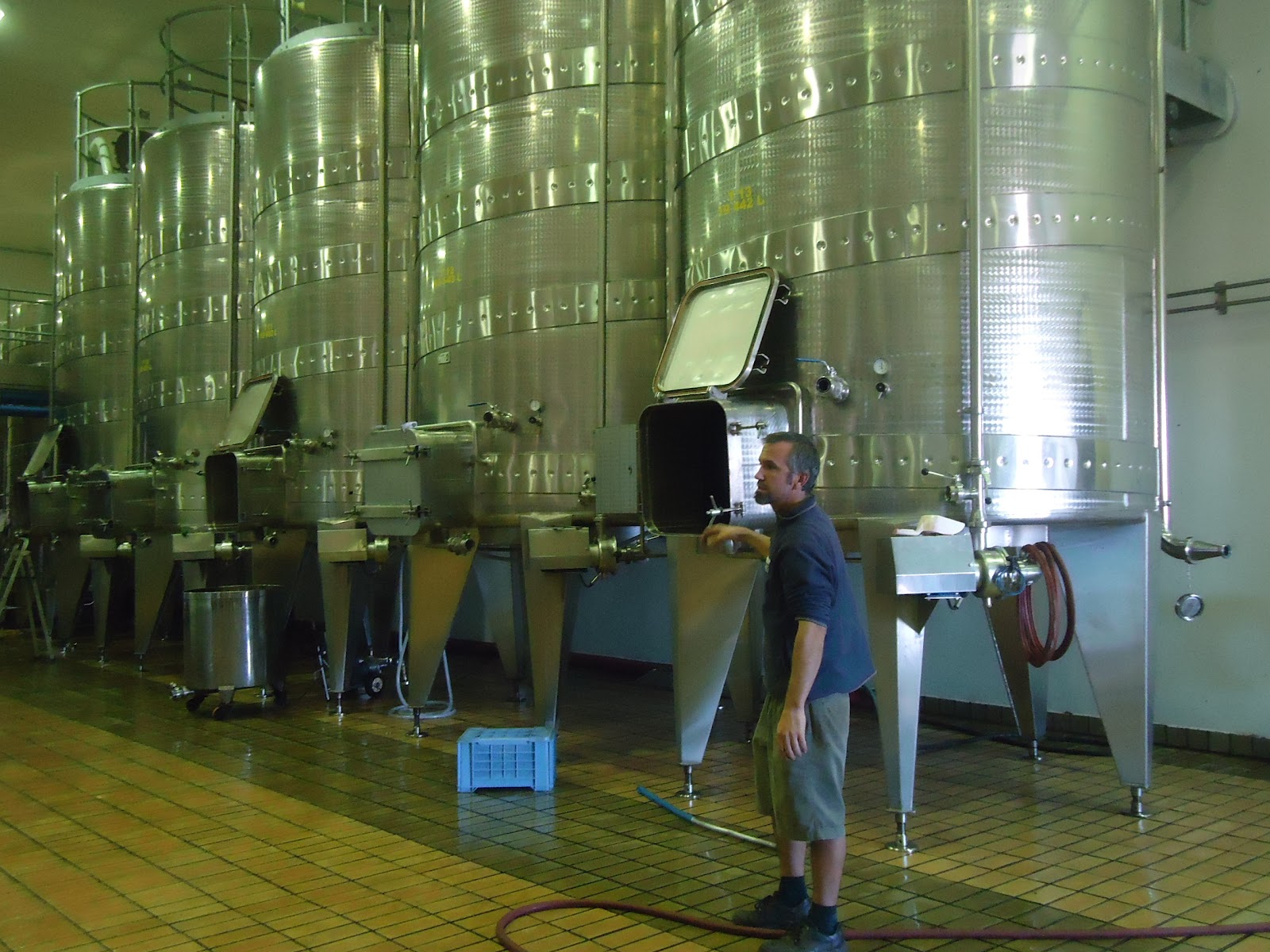
Our next stop was at Org Derac, a winery in Piketburg in the Cedarberg Mountain Region.  It was apparently an expensive hobby farm of a Capetown businessman, but now with the recession needs to make money like everything else.  They export a lot of their wine to Scandinavia and Germany.  The winery looked functional, clean and modern, but I didn't really care for any of the wine.  It is hot and dry here, and they just can't grow grapes like the ones in cool, coastal Stellenbosch.  One of the German girls, Annika, just completed a 7 month wine internship there and will be going back to work in her parents' winery in Germany.  I didn't learn that until after we had left, or I would have asked her opinion of the wine.  They gave us all a free bottle of wine, but not sure if we will actually drink it.


A rest stop on a long driving day

We spent the night at Blommenberg Guesthouse, which reminded me of an old Boer house with its high walls around an interior garden and pool, and many lovely, crafty touches.  I had some diarrhea in the morning.  Since someone had stolen all my medicine in Uganda and I had never needed it, I had to borrow some Immodium from one of the German girls since we drive 8-9 hours this day.
A drug sniffing dog came in our truck looking for drugs and guns


Hours of driving through desert
We continued on the Cape to Namibia Highway and finally crossed the border at the Orange River and came to Felix Unite, where we stay overnight in  little chalets that overlook the river.


River view from my chalet

Ivan in front of my chalet


Monday, April 2, 2012

WINELANDS


I left Capetown on the train on Friday for the one hour ride to Stellenbosch, an old Dutch settlement (1679) and home of the University of Stellenbosch, where my niece, Sara, did a college semester abroad.  The town is pleasant with wide, tree lined streets and a variety of architecture, including Dutch, Georgian, and Victorian.  Almost all the buildings are painted white, which I was told is to simulate the original Dutch whitewash.  Everything is so clean and white that it looks almost antiseptic.  One jarring note was the multi-story art museum at the University, which was red.

I am staying downtown at the Ikaya Hostel, which is a little funky but very well located, close to everything but away from the nightclubs so it is quiet.  My room has a balcony overlooking a park.  Next door is a large shopping mall which even has a movie theater.

It is a small town and easy to walk around.  It caters to students and tourists, so there are a lot of restaurants, fast food,  and coffee shops, as well as real estate offices and art galleries.  McDonald's is huge in Capetown, and there is a big one here, also.  

One of my first stops was the Village Museum, a collection of four restored houses that represent four distinct periods in the history of the town, from the 17th century Dutch  farmhouse to the elegant Victorian townhouse.  They have docents in each house dressed in the style of the period.  I went into the last house and the docent told me three times that it was the first house in town with a bathroom, so I was surprised to see no sink in the kitchen.  When I got upstairs to see the bathroom, I realized that it is only a room with a big tub and a wooden apparatus with a bucket shower.  In other words, a bathroom with no running water.  What a difference a hundred years has made, at least in this part of Africa.

18th century fire engine

17th century house
Victorian bathroom--no running water!


The University has a beautiful botanical garden, which is a peaceful refuge with lots of trees and water features, so you get a pleasant view, the feel of shade and the sounds of bubbling brooks.


On Sunday I took a wine tour (www.winelands.com) and enjoyed one of the best days I have had in Africa.  It had been raining on Friday when I arrived, but the rest of the weekend was beautiful weather.  We had a minivan with five Germans in their early 20's, a young Swiss couple, and a South African couple.  The latter is a nurse who manages a neonatal intensive care unit in Jeddah, Saudi Arabia, while her husband takes care of the house.  She just completed a correspondence course for a Master's degree in Nursing through the University and was here for graduation.  They eventually want to move back to their home here so bought about 30 bottles of wine throughout the day, so they are certainly stocked up!  They can't take the wine to Saudi Arabia.

Our guide told us that wines have been made here since the first settlers came in the 1600's.  In 1980 there were only 15 wineries, but now there are over 800, the majority established after the international sanctions were lifted in the 1990's.  A lot of them are run at a loss by South African businessmen, who apparently just like the lifestyle, but many are run by immigrants from Europe and the USA.  We started at one of the oldest wineries, Muratie, founded in 1679 by a Dutchman and his slave wife, who was apparently the love of his life.  She planted a huge oak tree next to the house that is still there.  When he died, she could not inherit the property, so she walked the three days to Capetown and told the authorities he was gone on a  hunting trip for three months and had instructed her to sell the place.  She got the cash and disappeared with her three children before they discovered the ruse.  The tasting room enough cobwebs that they may be the originals.  The wine cellar still has old concrete tanks, not modern stainless steel.  All the grapes are still handpicked and they were crushing them the old fashioned way, with the feet, until a few years ago.  This was some of the best wine of the day.


Muratie is one of the oldest buildings on the Cape
Muratie tasting room with cobwebs

The wine is made the old fashioned way

...with concrete tanks

List of owners since 1679


Our second winery was Tokara, which is ultra modern, large, and a totally different atmosphere than the first winery.  They also make several varieties of olive oil, so we had an olive oil tasting after the wine tasting.  A lot of us were hungry by then, so the chunks of bread used for dipping into the oil were welcome.  They have a nice looking restaurant and beautiful art throughout the building.

One of the legends in the area is a French nurse who inherited her family's winery in Bordeaux at the age of 50.  She eventually sold it and came to South Africa to start a winery at age 79.  She is now 95 and going strong, which she says is due to the wine she drinks daily.  Not a bad example to follow.


Art overlooking the stainless steel vats of wine


Wine tasting at Tokara

The next winery was Solms-Delia, a traditional South African winery owned by a neurosurgeon.  He reportedly knows every man, woman, and child on the estate and has created many projects to improve their lives, including a band and orchestra, and the workers give concerts and get extra money that way.  The original wine workers were mostly slaves.  After emancipation in 1834 they still got part of their wages in wine, known as the "tot" system, which led to rampant alcoholism.  If a husband worked on an estate, the wife was part of the contract, but if he died or was disabled, she lost her job and her home.  Now the workers have minimum wage and other laws to protect them.  We enjoyed a fabulous lunch at tables outside under the huge trees, then went to a different table for wine and cheese tasting, which was very pleasant.

Our fourth and last winery was Boschendal, one of the oldest Dutch wineries.  Our guide told us that Cecil Rhodes bought up a lot of wineries cheaply after the worldwide phylloxera fungus decimated the crops.  That guy knew how to make money, because after they grafted the grapes onto American fungus resistant roots the wine industry came back.  There is a huge grassy area in front of the house and barn-like building, reportedly because you needed a lot of room to turn around a team of oxen with a wagon.  We sat at large white wrought iron tables under a huge tree for our wine tasting, which made for a pleasant end to our day.  We got back to town around 6 p.m.


Boschendal colonial Dutch architecture

Wine tasting under the trees--German girls, me, and the South African couple


As I write this, I notice that not a single one of the wineries we visited is in the local free "wine route" guide or my Lonely Planet Capetown guidebook.  So I feel I "discovered" some gems, even though some of them are centuries old.  I couldn't have had a nicer day.