Friday, September 25, 2015

ESPINAL

9/8/15

That morning around 5:30 a.m. I was startled awake by a loud noise. It turned into several people chanting loudly as they wove their way around the aisles and floors of the huge hostel. This was the wake up call by the hospitaleros. The couple in the bunks opposite mine were up and gone within ten minutes, even though it was still pitch black outside. I stayed in bed awhile longer.

A big mistake was pre-purchasing breakfast the day before, although if I hadn't I wouldn't have got a ticket. I was scheduled for breakfast at the opening time of 7 a.m. I took my time washing up and re packing my pack. Another hiker walked by around 6:30 and I joked, "Getting an early start?" since sunrise here isn't till around 8. "No, I'm going to breakfast." That should have given me my first clue that you don't just go, sit down and get served.

I headed out the door around 6:45, thinking I had plenty of time to come back after breakfast to brush my teeth and go to the bathroom before they closed at 8. Two hospitaleros stopped me at the door as I was on my way to the restaurant where breakfast was being served. "Take your pack," they said,"because we lock the door at 8 and you can't get back in." My second clue. I dutifully went upstairs to get my pack then walked over to the restaurant and saw a long line of people waiting to get in. A few inquiries told me they all had tickets for 7a.m. Should I stay or should I go? I had already paid my 3 Euros for breakfast, so being cheap and not knowing what was ahead, I opted to stay in line.


 About 45 minutes later, I finally claimed my toast, jam and coffee. I had to clear the dishes off a table so I could sit down. I was joined by two other peregrinas and we had a pleasant chat over breakfast

I headed out with the two girls to make sure I was going in the right direction for my first steps on the Camino. A sign showed I had 790 km (over 490 miles) to go. The girls sped off at a quick pace after a "Buen Camino!" The Trail was wide and many others walked past me. 
They say you find others who walk the same pace as you, but so far they hadn't materialized. 

After about twenty minutes I saw a few restaurants with pleasant outdoor tables.
That would have been a better place for breakfast, but I'm not sure how early they opened. I'm told that 9 a.m. Is the typical time. Rather late for me. 


After a pleasant walk through woods and  hilly farmland, I stopped around midday at Espinal, a village of a few blocks with green hills all around. I had a lunch of salad, bread and coke light then walked around the village a bit. I'm staying in a 16 bed dormitory at the Hostal Haizea. That sounds like a lot but nobody checked in till several hours later, so I could do my laundry and enjoy reading on the sunny deck. 

That night we all gathered for a pilgrims' meal in the downstairs restaurant: grilled ribs, spaghetti, meatballs, fries, bread, wine. It was pleasant getting to know the other pilgrims from the UK, Australia, Zambia, Italy, Serbia, and Russia.

Only four miles by the Camino guide, but you do a lot of walking besides that. My Fitbit says six miles today and my poor foot says "enough!"


.

Thursday, September 10, 2015

RONCESVALLES


I feel like I cheated by taking the bus the first leg of the walk but I was not alone. Along with my Achilles tendinitis, there were walkers with hip, knee, shoulder and leg problems. We're all determined to go on, though. We just couldn't face the initial 15 miles with 4,500 feet elevation gain.  One person on the bus was an Italian cyclist who thought he could rent a bike in St Jean but there were none to be had. A lucky escape, I say. He has to go all the way to Pamplona to get a bike.

It took about 45 minutes by bus to get to Roncesvalles, which consists mainly of an old Medieval hospital made into a 400 bed hostel, a couple of hotels, and restaurants. It sounds like a lot, but they were full and turning people away by late afternoon. So the people who were late getting over the Pyrenees had to struggle on to the next hostel up the road. 


I had time to take a tour of the Church of St Mary (1219) and the crypt where thousands of Charlemagne's rear guard are supposedly buried in a mass grave.
In the winter the snow can get to the upper windows. Some of the pathways are beautiful old stone mosaic.


We were all served a Pilgrim's meal for 8 Euros. They are a custom along the way and are supposed to sustain us through the next day of walking. This one consisted of salad, fish in white sauce and fries, wine, bread, and ice cream. My three tablemates were a German family that spoke no English or Spanish, but we managed to communicate in the universal language of hands and grunts. The daughter is vegetarian and ended up with a plate of French fries for dinner. We are supposed to pass a market in the next town, so hopefully she can get some healthy snacks.


After dinner we attended a pilgrim's mass in the church and we're all blessed. There were five older priests. One of them looked like he was a hundred years old. This must be a retirement posting for Catholic priests.

Wednesday, September 9, 2015

ST JEAN PIED DE PORT

The bus ride from Pamplona over the Pyrenees mountains to the French town of St Jean Pied de Port was through beautiful green rolling hills, dotted with sheep and cows. I shared the bus with many other Pilgrims of many nationalities. I'm sure it crossed all of our minds that we would be walking a similar path back to Pamplona, including steep ascents and descents and hairpin turns.

St Jean Pied de Port is a lovely Medieval town with a fortress and old stone buildings lining cobblestone streets. I met June from Korea as she was trying to manage a 50 pound backpack, a roller bag, and a large shoulder bag. One of the jokes of the Camino I have heard is that if you need something, ask a Korean--they carry everything! Poor June was a good example. I walked with her up to the Pilgrim's Office, which was closed for Siesta, so we opted to go to a French restaurant for lunch so we could set our luggage down. 

The meal was wonderful--roasted chicken, baked potato, vegetable salad, and an apple tart for 12 Euros.

Over lunch, June shared with me that she had worked three jobs to save for this big trip. It was bigger than I had imagined. She had flown to Vladivostok and spent a month crossing Russia to St Petersburg before flying to Madrid and right away getting on a night train to Pamplona and then the bus to St Jean. Needless to say she was exhausted. Her last shower had been in Moscow.  I asked what she thought of the steep downhill on the bus and she had slept through it.  

June's further plans after walking the 500 mile Camino are to go visit her parents, who are missionaries in Tanzania, tour around Africa, then go see "the big waterfall" in South America. Quite an ambitious itinerary. I did talk her into shipping her roller bag to Santiago and sending her backpack ahead to her first overnight stop after the steep ascent the next day. When I saw her the next morning, she had arranged all this through her hostel, but somebody stole the envelope with 70 Euros she was told to leave on top of her luggage for the transport company.

We returned to the Pilgrim's Office after lunch.  After the volunteer carefully explained to me the two options of hiking routes over the mountains, I knew for sure I would be taking the bus this first leg. My poor foot can't handle the 3000 foot elevation gain. 

I stayed at Gite Izaxulo and shared a room with a Canadian and a British guy. All of us were too tired to do much more than exchange Names.

Pamplona

I arrived successfully by train, despite a threatened railway strike. I had planned on walking to town but I'm glad I broke down and took a taxi. The seven Euros was worth not having to deal with busy traffic and a convoluted route. The driver couldn't take me all the way since some streets were blocked off for a fiesta. There were stands all over selling arts and crafts, homemade food, and religious articles. 

I'm staying at the Hotel Maisonnave, smack in the middle of Old Town and one of the cheapest things I could find on the Internet. Of course, when you get here there are lots of things cheaper that save money by not advertising. But it's a good feeling to know you have a bed somewhere with your name on it.  

I checked in then went looking for the bus station to get my ticket for tomorrow. It is another part of town. I asked directions of a pleasant looking older man. He said he was on his way to the station and would walk with me. Mikel is a Pamplona native and only speaks Spanish and Basque. He is also deaf in one ear but we were able to communicate alright. He is also divorced and has one son, aged 36, just like me.

We got to the bus station, which was underground and doesn't look like a bus station, so I was glad he was with me. He bought his ticket to go visit an artist friend but the woman said there were no buses to St Jean the next day since it was Sunday. It didn't show on the wall schedule either. My new friend saw a bus ready to leave for St Jean and asked the driver. He was busy taking tickets but after a few minutes he took me into the terminal and showed me how to buy a ticket at a machine for his specific company. So I now had a ticket for the next day.

My new friend had a couple of hours before his bus departed so he gave me a walking tour of Pamplona. I saw the old citadel, the bull pens and the route the Bulls take when they are let loose to go through the old city each July for "the running of the Bulls." I also saw my first Camino marker in Taconera Park, a silver shell embedded in the pavement. He showed me his favorite restaurant but lunch was already done. He had to go catch his bus but showed me an easy way to get to the station the next day before he kissed me on both cheeks and took off.

I found a place in old Town that agreed to feed me a meal of chef's salad, grilled salmon, potato, bread, wine and tiramisu for dessert. I went back to my room happy, ready to tackle packing for the next day.


Tuesday, September 8, 2015

STUFF

I had a panic attack my last night in Madrid. How am I going to fit all this stuff in this small backpack and how am I going to carry it all to Santiago?

I had already left a lot in Asheville, but I decided to purge some more. I tossed aside my cute clamshell leggings, a t-shirt, and my hat. Multiples of bandages and medicines were put aside. I threw away all excess receipts and paper, including my journal (still virgin). The only things I would not compromise on were my rain she'll and my fleece, since getting caught on a trail miles from anywhere in rain or cold is more misery than I can contemplate. Everything excess went into the red duffel, which started to look like it was holding enough for an entire trip. Shower sandals, tape, extra food, energy drink powder. I was ruthless. I ended up with a much lighter pack and was able to abandon my idea of having things dangling outside, since everything now fit inside. The only problem was that I would now have to be storing the roller bag I had intended to trash in Pamplona. Did I subconsciously overpack on purpose so that I wouldn't have to lose my old friend?

The Camino is supposed to be about getting rid of excess baggage--physical, mental, and spiritual. I feel like a failure already.

Palacio Real


Friday, September 4, 2015

THE REAL MADRID

Wow, I have a whole day in Madrid and I have to make it count!

I didn't sleep well at the hotel.  At 1 a.m. someone passed my door with a really loud roller bag.  At 2 a.m. someone came by to noisily join a party in progress, which was pretty quiet until he got there. Did I mention the walls are thin? I finally slept and woke up at 8.  My body told me to go back to sleep and I woke up at 10.  I finally left the room at 12, ready for my first "whole" day in Spain.

I had originally planned to visit a couple of the big art museums that are very near the hotel.  I looked at the map and saw that the Royal Palace was less than two miles away, a good walking distance for me.  I would rather look at history than Picasso, so I made that my goal.

Actually, there are several royal palaces, and many Royal buildings on the map.  I passed Royal Academies, Royal museums, etc.  "Real" is "Royal" in Spanish.  After many difficult years under dictator Francisco Franco, the Spanish love their royal family.  However, King Juan Carlos did get in trouble with the public for going on a luxury African safari when the people were suffering unemployment over 23%.  The safari was actually paid for by a Syrian businessman, but the King said he didn't want his son "waiting forever like Prince Charles." After almost forty years in power and overseeing the government transition to democracy, the King abdicated in favor of his son, Felipe, in 2014.  I think Elizabeth does not want to see Charles and Camilla taking over, and William is enjoying his young family life too much.  So she waits.

It was a pleasant walk to the Palacio Real. There are lots of tourists and many different languages around me.  I see a lot of short short denim pants, but I am out of the fashion loop and don't know if that's a local thing or a broader fashion statement.  We had similar "hot pants" in the 1960's, but I don't remember them being made of denim, except perhaps for Daisy Mae Clampett's.

The Royal Palace is huge, consisting of a large courtyard surround by three legs of the multistory palace, anchored by a large church on one end.  One leg holds the Armory, which contains ancient suits of armor and even life sized horses fully armored except for their legs.  Some of the gauntlets had sharp spike across the knuckle area, so a slap by the back of the hand would have caused serious damage.  Some helmets had curled horns in the ear area, which I guess was to make the wearer look more fierce or godlike.

The Palace itself is no longer lived in, but is used for ceremonial occasions.  The dining room must sit over a hundred people.  The throne room was sumptuous, of course.

I started walking back to the hotel and opted for some interesting detours through diagonal streets and plazas.  Forty five minutes later I was back at the palace, even though I could have sworn I was heading in the direction of the hotel.  At this point my foot was hurting, so I quickly went the direct way home, stopping only to enjoy some Spanish paella and wine at an ancient looking bar/restaurant.  It was not what I expected. The rice was lukewarm, maybe because I was again eating my dinner after 4 p.m. when lunch service was officially finished.  The paella also was very crunchy, and I had to pull a lot of shrimp fins, chicken bones, mussel shells, etc out of my mouth.  I have heard they put "everything but the kitchen sink" into paella, and this was an example.


Thursday, September 3, 2015

SEEKING SIM

I can't sleep on planes.  I felt like I had dozed, but my fitbit didn't log any sleep.  So I landed in Madrid at 11 a.m., kind of groggy but ready to take it on.  I didn't have a guide book but knew my first item of business after getting my bag was to find the RENFE, or train station, and get a senior discount pass, which would entitle me to 40% off on the trains.  I always remember advice like that, even if I don't know where I'm supposed to go.

|I had to go down the crazy little steps to get off the plane, a real challenge with hand baggage and no sleep, then walk forever to get to the main part of the airport.  The main airport is beautifully set up for tourists, with bus, Metro and distance trains right there. I found where I needed to go and bought an immediate ticket to get downtown and a ticket for Saturday to Pamplona.  I had booked a small hotel right across from the train station so I wouldn't have to walk far with my luggage.

It took me a few tries to figure out which exit to take out of the huge train station, then to find the "right across the street" hotel whose street wasn't shown on my map and nobody I asked knew where it was.  A helpful man whipped out his cell phone and found "Calle Dr. Drumen" and directed me.  It parallels the main street and is definitely tourist oriented, with a McDonalds, KFC, Burger King, and Starbucks all on one block, along with numerous sidewalk cafes.  Hostal Buelta was smack in the middle of the block, but I was too early to check in.

I asked about finding a Spanish SIM card for my iphone so I could avoid Verizon roaming charges. The man at the desk told me there was a phone store "right up the street, not sure how far."  I left my roller bag and went out for a walk in the beautiful sunshine.  The neighborhood consists of a mix of government and commerical buildings made of stone.  The sidewalks are wide with room for plenty of sidewalk cafes.  Many shops are closed due to Spanish siesta time, from approximately two to five.  After walking about a mile uphill, I hadn't seen a phone store.  In Africa and Latin America they are all over.  I decided to get my tired body back to the hotel, rest till the shops reopened, and try another street.

Around four, I opted for dinner at one of the lovely sidewalk cafes.  My dinner is actually lunch, since Spanish custom is to have supper at 9 or 10 at night. If I wanted to eat, I had to get to one before they closed lunch service.   A lot of the restaurants don't even open till 9, and nightclubs don't open till midnight.  When do these people go to work in the morning.?  The restaurant I chose specialized in calamari, even though Madrid is far from the ocean.  I wanted something little and asked for a local beer and a mini bocadillo, the classic Spanish sandwich.  I got a slab of chicken on a dry French roll, with no mayonnaise, tomato, lettuce, or anything.  Well, it was cheap and I got to watch the people go by.

I had better luck on the other road I chose to walk along.  I passed the Prado, a famous art museum, and walked about a mile up and found an internet store that sold SIM chips.  Ten Euros for two gigabytes of data, plus 8 mb of talk/text.  The owner changed the SIM card for me and I was careful to store my Verizon card where I could find it again.  Interestingly, I still got a couple of texts on my Verizon phone number after this, so I'm not sure how that works.


Tuesday, September 1, 2015

PREPARING FOR THE CAMINO

For about nine months I have been planning to walk the Camino Frances, a 500 mile trek across northern Spain. Why? Because I can (maybe). Because, at 63, I feel age creeping slowly into my body and that a withering crone is in my future. A good diet and lots of exercise might stave her off for awhile, but my intentions are always much better than what I actually do, so she is there, waiting for me.

People ask me if I got the idea for this journey from watching Martin Sheen in "The Way." Actually I never saw the movie till about two weeks ago, when I saw that it was free on Amazon Prime. I watched it again last week on Netflix with my daughter-in-law in New York. She fell asleep, so it can't be that exciting.

I first heard of the Camino when I bought Shirley MacLaine 's book of the same name in 2000. It sat on my shelf and went through several moves with me till I finally read it this year, after I had already decided to go. Honestly, I couldn't finish it. I gave it away as soon as I could. I have no intention of being visited by all the wacko spirits she conjured up along the way. Shirley, you're crazy.

There is an active Camino group where I live in Asheville. They meet weekly at a local coffee shop. The three times I went, there were 10-20 people there, and all had gone at least once. The local REI outdoor store has Camino lectures once a month, and I have been attending those since January. The room is always full and there is a mix of those who have been, those who want to go, and those who are trying to figure out what a Camino is. (The word means "walk" in Spanish.)

So I have been preparing for awhile, trying to figure out how little I can carry on my back since I don't want to finish as an invalid after carrying half the contents of my closet for 500 miles. 

The prevailing wisdom is to take two sets of clothes, one to wear and one to wash. I have trouble with that. A young fit person can do this journey in under a month, walking about 25 miles a day. I am planning on two months, staying in some towns to "smell the roses,"more likely wine grapes, along the way.

Another big issue is getting the right shoes. I'm taking a pair of Brooks Cascadia trail runners, walking sandals, and flip flops for the shower. Taking only one pair of sandals is recommended, but I hate to get my walking sandals wet before t wear them out to dinner, and I need sandals for the communal showers in the hostels so my feet don't pick up some weird fungus and rot off. On a 500 mile walk, your feet are your most important asset. Some people wear Crocs, but my feet don't like them.

A wrench in my plans came when I developed painful Achilles tendinitis about two months ago. I had plantar fasciitis about ten years ago that took two years to get rid of, and I hoped this wasn't the end of my plans. An X-Ray showed a bony projection, or heel spur, on my right foot. My podiatrist prescribed ice, exercises, and alternating my daily training walks with pool walking days. I was told to walk in the pool for the same amount of time as I walked on land. I have access to a pool but I found walking in it incredibly boring. It's not like I could take my iPod in. My training walks were never more than five miles, and my pool walking was never more than an hour.

As a result, I am not in the shape I want to be in for this journey. My podiatrist and several friends questioned if I should go. My thought was that I could always find a beach city in Spain somewhere and hole up for the duration.

Another worry is that the first day of the walk has a 3000 foot elevation gain over the Pyrenees then a steep descent. Many people, especially older ones like me, wrecked knees and feet so badly on this part that they had difficulty continuing. There is only one hostel on the way up and it was already booked up. My former teacher from UNC, who has walked the Camino several times, advised starting in Roncesvalles, after the Pyrenees. I felt like he had given me permission to avoid the difficult part. "Make it YOUR Camino," he said, and I have taken those words to heart.

I still have right heel pain, especially when getting up or after walking 2-3 miles. My podiatrist gave me an okay to go, along with prescription strength ibuprofen.

After frantic last minute packing, I decided to put my backpack and trekking poles, which have metal tips and are not TSA friendly, into a wheeled duffel bag I had set aside to donate to Goodwill. It has one rubberless wheel but still rolls noisily. It is an old friend that has been around the world with me and on long trips to Africa and South America. I somehow feel better that my old friend, who like me is slightly broken and has seen better days, is accompanying me on the first part of my journey.

I will take it slow and modify along the way if I need to, even if that means there's a Spanish beach in my not too distant future.


Friday, May 24, 2013

TO ASHEVILLE


It was expensive to fly from Ft Lauderdale to Asheville, especially with luggage, so I opted for a cheap deal on a rental car and took two days to drive up (770 miles).  With hotel, food, and sightseeing, it ended up costing about the same as the flight.  After two years away, I thought the gradual "decompression" would be best.

I drove up the coast of Florida the first day, vaguely planning to stay in Savannah overnight.  Well, that was a ways off the highway and the hotels were expensive, so I opted to stay overnight near Brunswick, Georgia.  I visited the Hofwyl-Broadfield Plantation the next day and learned all about antebellum rice farming.  I knew nothing about this, thinking the South was all about cotton.  Rice was actually a major crop until they started growing it better and cheaper in the Western U.S.  Like the Biltmore House branch of the Vanderbilt's, the family turned to dairy farming to survive.  Unfortunately, the last unmarried daughter died in 1973 and the plantation ended up in state hands.  They did live very well in their heyday, traveling to Europe to furnish their more elaborate mansion in Charleston.  At one point the plantation had 357 slaves.


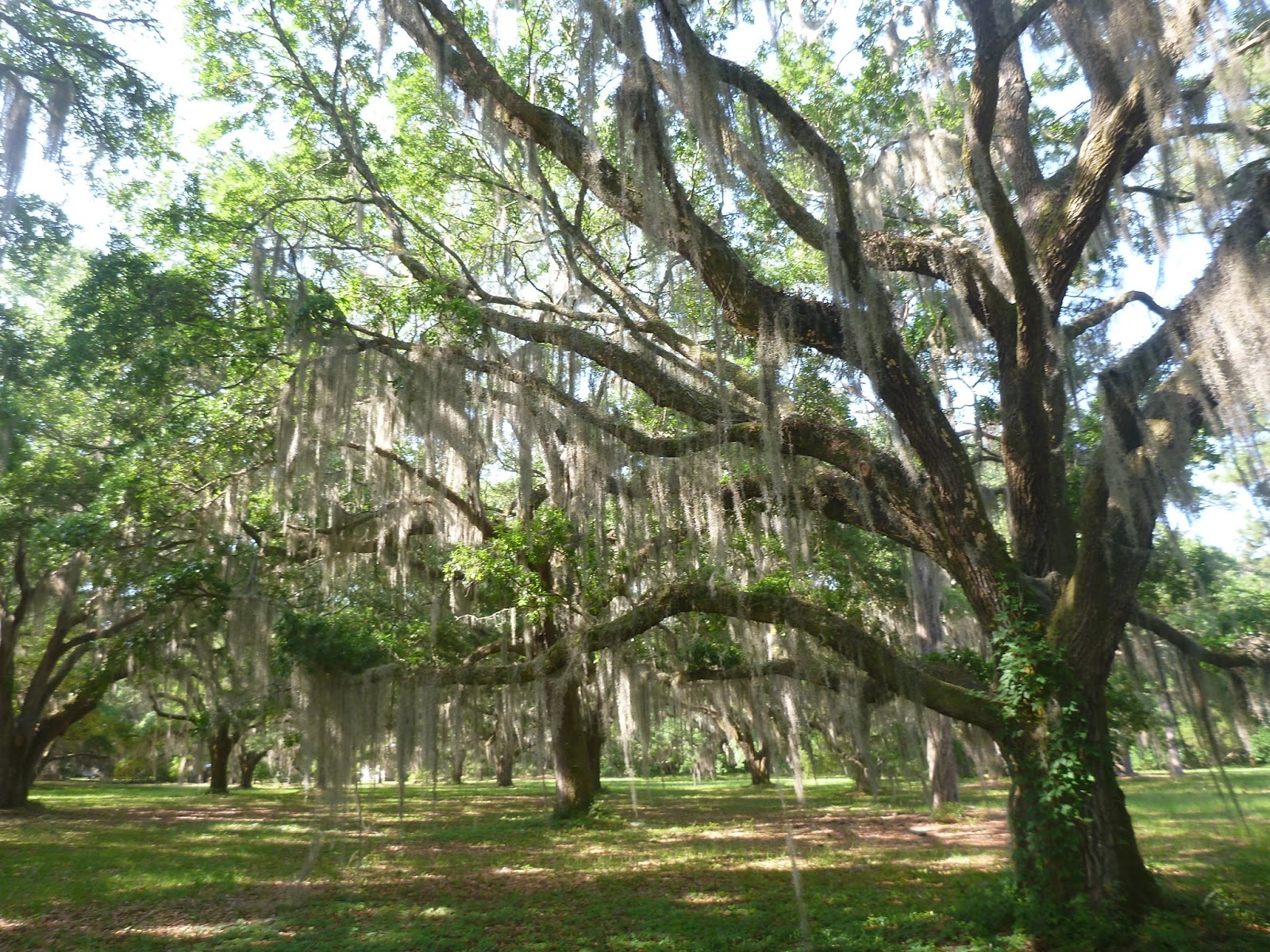
Hoftwyl-Broadfield Plantation-lots of oaks and moss

Plantation House circa early 1800's
The next day I continued the drive through Georgia and South Carolina, stopping occasionally to look at interesting things.  I finally arrived in Asheville that evening, and went to dinner with my next door neighbor, Deborah.  I stayed at her house for two nights before the movers came with all my stuff that had been in storage for two years.  It was really disconcerting to see all those boxes when I had been basically living out of one suitcase for so long.  But having a lot of STUFF is the American way.   I didn't get rid of as much as I thought I had, which was a good thing in that I didn't have to replace much.

Moving in wasn't hard, since everything pretty much went back where it had been before.  My only issue was that the renters, who moved out last October after a military transfer, took all the cleaning stuff I had left, like vacuum cleaner, mops, buckets, stepstool, etc, so I did have some things to buy.  The management company was very nice and replaced the vacuum cleaner and had someone come and fix the holes in the walls.  I remember having to fix that kind of stuff when I was a renter so I could get my deposit back, but I guess they don't do that anymore.

Friday, May 17, 2013

FT LAUDERDALE


The final days at sea were eventful but relaxed.  I attended several lectures by a physicist on astronomy and learned about comets, eclipses, and our universe.  I haven't been following this in recent years and missed that Pluto is no longer considered a planet.  One planet (Venus?) has heavy  clouds of carbon dioxide, which cause an atmosphere loaded with sulfuric acid and temperatures of 700 degrees.  Is this our future?  We get a six page mini New York Times, that has an article stating that we have just passed the dreaded milestone of 400 parts per million concentration of carbon dioxide in our air, "a march towards disaster."

I also took several classes on computer photo editing and the new Windows 8 program.  I am not planning on switching from Apple, but thought it would be a good thing to know if I run into it in the future.  The main change is that it uses touch screen a lot instead of the mouse, just like you would do on an IPAD.

A lot of our events are food oriented: an international fair with booths of food from different countries; Dutch and Indonesian High Teas instead of the usual Earl Grey and scones; an early Memorial Day BBQ with chicken, pork, fish and steak; more free cocktail parties to celebrate the end of the voyage.  I am skipping more and more meals since I can't keep up.  The scale here shows that I haven't gained any more weight, but it sure feels like I have gained 20 in the past two weeks!  All this will change soon when I do my own shopping and cooking.  I have been going to the cooking demos on the ship, which include a lot of high calorie foods but also simple fish and chicken recipes. 

I have not done any dancing, casino, or stupid cruise games.  The weather has been pretty good, so just reading on the deck is nice.  Occasionally I walk a few times around the promenade deck, but haven't hit the gym much.  I am excited about getting back to Biltmore Lake and walking the trail around it for my daily exercise.  

Tuesday, May 14, 2013

BERMUDA


We were scheduled to get into Bermuda today at 8 a.m., but since we missed out on Horta, the captain decided to get there faster.  We docked in Hamilton, the capital, and were able to get off the ship about 4 p.m. yesterday.  We were conveniently docked downtown and had many shops right across the street.  My main interest yesterday was to get wifi, which I found in the library., about three blocks away.  I was able to answer some emails, a lot about my upcoming move back into my home after two years away.  I was finally able to arrange to turn the water on in the house, so I can get it cleaned and ready for the movers before I get there.  It was cleaned after the last renters moved out, but has been empty since August, and I would rather someone else deal with the resident critters and dust that have probably accumulated in the past nine months.

Bermuda consists of 138 islands with a total area of 27.7 square miles.  It is a British territory with a Governor appointed by the Queen.  It was  discovered in 1509 by Spain, but they were preoccupied with their rich settlements in America and did not settle in Bermuda.  

In 1609, an English ship carrying colonists and supplies to the new settlement in Jamestown, Virginia, wrecked in Bermuda.  The wreck supposedly inspired Shakespeare's play, The Tempest.  Everyone survived the wreck and they built two new ships from salvage and native cedar before heading on to Jamestown.  The Virginia colony was starving, so they headed back to Bermuda to get some of the abundant food they had found there.  In the meantime the captain died, and his nephew decided to go on to England instead of returning to Jamestown, which floundered without the promised supplies.  The captain's body was taken to England for burial, but his heart literally remains in Bermuda.  

Bermuda was permanently settled by the English in 1612 as a way station for ships going to and from the colonies.  It became more important after American independence.  During WWII the British traded a 99 year lease on two military bases for 50 American destroyers.  At one point the US had thousands of soldiers here, but the leases were given up 15 years ago  when the US was going through a rash of base closures.  An international airport, schools, and churches were built on the site.  The barracks now provide housing for low income Bermudians.

Ft St Catherine
St George was the first capital and is now a UNESCO World Heritage Site.   A prominent feature is King's Square, named after George III, which has replicas of stocks, pillories and a dunking stool.  We watched a reenactment of a woman being dunked in the adjacent harbor for "nagging and gossiping."  We also visited St Peter's Church, the oldest Anglican church in continuous use outside of the British Isles. which was built in 1612 and rebuilt in 1715 after a hurricane.   A lot of the graves and plaques in the graveyard are for early settlers who died from epidemics.  There was a separate graveyard for slaves.

Nearby is Fort St Catherine, built in 1614 by Bermuda's first governor and now a museum.  It overlooks the site where the Jamestown settlers became shipwrecked in 1609.  The stone ramparts have lots of old cannons looking out to the ocean.

Replica of the Deliverance, made by the survivors after their ship wrecked here in 1609
The beautiful Botanical Gardens opened in 1898 and cover 36 acres.  Besides ornamental horticulture, there is agricultural research and an art museum.

Grave at St Peter's Church


Tourism is the main industry.  We saw three other cruise ships while we were there, and they were expecting a "megaship" of 5,000 passengers the day we left.  Offshore businesses are the second main source of income, although with new rules it is not the tax haven it used to be.  They have 7,000 foreign workers.  Our guide pointed out homes of Ross Perot and Michael Bloomberg.

Lots of yachts!


They have good roads, but owning cars is discouraged with a 75 to 150% tax and $8/gallon gasoline.  Public transportation is well developed with ferries and buses.  The international airport has about seven different airlines using it.

We were only one in a line of cruise ships leaving Bermuda
Bermuda has no rivers or freshwater lakes.  Drinking water is collected on the roofs of buildings and stored in underground tanks for each home or property.  You see endless white roofs made of lightweight coral limestone.  These are washed periodically with a mixture of lime and chlorine, which purifies the water before it runs into the tank.  There are also some desalinization plants, but the water from these is very expensive.  They do have hurricanes here, and the houses are built to sustain 170 mph winds.


The Bermuda triangle, with apexes in Bermuda, Miami, and San Juan, Puerto Rico is said to be responsible for mysterious shipwrecks and plane crashes.  Other well known terms are Bermuda grass, Bermuda shorts, and Bermuda onions.

Saturday, May 11, 2013

AT SEA

What do we do on board ship?  A lot of it is just waiting for the next meal.  The Prinsendam is the smallest Holland America ship and goes to ports the big ships can't.  Most of the people on the ship had started in Ft Lauderdale and were finishing there, a 62 night Grand Voyage across the Atlantic and around the Mediterranean and back.  I was only on for the last two weeks, from Barcelona to Ft Lauderdale, so people pretty much knew each other and had their routines.

  There were lectures, dancing, bingo and other games, a beautiful library, and food, food, and more food.  They had Happy Hour, so you could get a glass of wine or something before dinner and take the second free one in with you to the dining room or wherever you wanted to eat.  Sometimes I skipped the formal meal and just got a hamburger and two for one beers on deck.  They also had a nice buffet with lots of regular and "Asian fusion" food.  And don't forget the ice cream bar!

We had a beautiful seafood buffet on deck one day, all locally caught, and they showed some pictures or had the heads of some fish, like the 8 foot tuna.  I especially enjoyed the afternoon tea every day at 3 p.m., with live chamber music and to die for scones and cream.  Didn't help my waistline, though.  Luckily there was also a beautiful gym on board, and not many of this mostly older crowd used it.

At 9 p.m. there was usually entertainment and dancing, but I rarely made it.  Too much!  They did have some good entertainment.  They had contract performers that stayed on for all or part of the voyage, plus local musicians, comedians, puppeteers, etc that came on for a few days.  An example was the fabulous Flamenco group that joined us in Barcelona and left in Cadiz.

One night we celebrated the 140th anniversary of Holland America, and the pastry chefs went wild!


My favorite (and calorie free!) things were the little folded towel creatures the cabin crew left on my bed every night, along with a piece of chocolate and the schedule of activities for the next day.  I actually took a one hour class in how to do these, but the crew gets two days of this in orientation and I couldn't begin to rival them.


Thursday, May 9, 2013

THE AZORES


On May 8 we reached Punta Delgada on Sao Miguel, the largest and most populated island of the Azores.  All of the nine islands are volcanic in origin, and there are many craters and geothermal features. It is part of the mid Atlantic ridge, the world's longest submarine mountain range, formed 250 million years ago. The first recorded sighting was by the Portuguese in 1427.  It remains a territory of Portugal, 900 miles away.

Sete Cidades Lake


I took a trip to Sete Cidades, named after the seven kingdoms of Atlantis, which the Azores are supposedly the remains of.  The village is on the shores of two crater lakes divided by a bridge.  One has famously blue water and the other green, but the color difference is because of the algae on the green side.  The day was overcast, so they looked much the same to me.  The village was small but modern, and seemed a different world from villages in Africa.  We stopped at a picturesque church.

On returning to Punta Delgada, we went to a tasting of local wine and cheese  in the harbor area.  I enjoyed both.  After going back to the ship for lunch, I walked around the town.  It was frustrating not to be able to get internet to work at the shopping mall.  By this time it had started to rain pretty heavily.  We were lucky to be in town at the time of their major festival, Senhor Santo Cristo dos Milagres, but the rain put a damper on the many lights and flowers that make the festival famous.
Horta

Pico Island
One of our engines is not working, so we stayed in town several hours past scheduled time for the part to be flown in, along with the technician to do the repairs.  The engine was eventually fixed, but one of the stabilizers was out, so we were unable to get off the ship in Horta, our scheduled port the next day, because the ocean was too rough for the tenders without having the stabilizer.  I did get pictures of Horta, on Faial Island, and nearby Pico Island as we sailed away.  

Sunday, May 5, 2013

SEVILLE

My new home for two weeks

Sailing aboard a Holland America ship is certainly different from a student ship like Semester at Sea.  The main focus is body, not mind, with emphasis on food.  Breakfast is available at 6 a.m. and the food circus goes on in many venues till midnight.  I took a tour of the food galleys and it looks like they use as much food in a week as SAS did for a whole semester for roughly the same number of people! In an average week, they use 6,400 pounds of meat, not including poultry and seafood, 12,040 eggs, and 2,500 pounds of butter.  We only have about 550 passengers!   The quality is a world apart also, with beautiful presentations of luscious meat, fish, pasta, salad, and dessert dishes.   They seem happy to cater to whatever you wish, also.  A far cry from the buffet lines of mostly rice, pasta and unrecognizable main dishes in the SAS buffet.  I was not tempted to gain weight there, though.  We will see what two weeks on this cruise does to my waistline.  It is too much, though, and I already find myself skipping meals due to overload!

On the third day we docked in Cadiz, Spain for a day.  Cadiz is the oldest city in the Christian world, with walls built in the reign of Julius Caesar.  The port took in much of the wealth that came to Spain from the Americas from the 15th century on.  The name of the region, Andalusia, means "land of the Vandals," from the Visigoths who displaced the Romans.  There were subsequent invasions from Arabs, Berbers, English and French.

Cadiz, Spain


Fans for sale
I took a day trip to Seville to see the Alcazar, the oldest royal palace in Europe, built by the Moslems in the 11th century.  Adjacent to it is the third largest gothic Cathedral in the world, built in the 15th century on the site of the old mosque.  The tower remains.  The son of Christopher Columbus is buried in the Cathedral, and an honor guard of four statues carries some of the remains of the man himself, although he was buried in Santo Domingo.  His body was apparently moved a few times and lost pieces with the moves.  The idea of being cremated and scattering ashes doesn't bother me, but scattering body parts, or "relics" is pretty gross.

In the 15th century, Seville was the fourth largest city in Europe, after London, Paris and Naples, with a population of 130,000.  In 1649 it lost half the population to epidemics.  There is an old Jewish quarter, but most of them were banished in the Inquisition.  What remains of the old city is a pleasant blend of narrow and windy cobblestone streets, wide plazas, and beautiful parks.  It is very peaceful, but the history has been violent at times.  The city has grown a lot.  Major crops are grapes and cork, an excellent basis for their wine industry.

Gate into the Alcazar palace
Seville


As we left town, we visited Plaza de Espana, built in 1929 for the Ibero-american Exhibition.  The surrounding area has many beautiful buildings built by various countries for the exhibition, many of which remain as consulates for those countries.

Wednesday, May 1, 2013

BARCELONA


I was anxious to see Barcelona, since my son calls it his favorite city in the world, and friend Karen Curtis says you need at least two weeks to see it properly.  I have a week there before getting on a ship to Florida.  

The first four nights, I stayed in an apartment in the Eixample District with five other SAS people.  This ended up being very nice and pretty cheap at about $125 for my share.  We had three bedrooms, two baths, a kitchen, living room and wifi.  It was very comfortable but the design is a little strange.  You couldn't swing open or close the shower door without leaving the sliding door to the hall open because of its protruding handle.  Also there was a glass block wall between the two toilets, so having two people use the toilets at the same time was a little disconcerting.  This is Europe, and I guess they don't have the same privacy concerns we do in the US.

Our first day, we all went to a Tapas lunch before visiting the Sagrada Familia, Gaudi's famous church, which has been under construction for over 100 years.  It is medieval in feel.  They still have many projects left to complete, but it is still awesome.  


100 years and still under construction
The interior is supposed to look like trees


Casa Batllo


I went on my own to Casa Batllo, another Gaudi masterpiece, the next day.  It was built around 1895 as a residence for a Spanish industrialist and his family.  It is a contemporary of my old stomping grounds, the Biltmore House, but seems eons advanced in design, though George Vanderbilt thought he was way ahead of his time with his central heating and two elevators.  His house still felt very Victorian, while the design elements of Casa Batlio are taken from nature and make it reminiscent of the colors and fluidity of the ocean.

I also visited La Pedrera, Gaudi's apartment complex nearby, but did not want to wait an hour in line to get in.  Same thing for the line at Palau Guell, off of Las Ramblas.  I did go to Park Guell the next day to see his idea of a rural-urban environment.  It is up steep streets reminiscent of San Francisco, but they have outdoor escalators to get you up a lot of the steep parts.  I went with Susan and Armin, but ended up walking home on my own because I wanted to stay longer.  It was all downhill and through some charming neighborhoods.

I thought I lucked out when I got to the Picasso Museum and the line was not very long.  Then someone came by and said it was closed for the day because it was Labor Day.  Sure enough, May 1 is Labor Day in Spain and most of the museums are closed.  So after standing in line for awhile for nothing like a stupid tourist sheep, I took a nice walk along cobblestoned Las Ramblas and went to the Central Market.

Barcelona cathedral
Gothic quarter
I was intimidated at first by the windy, narrow, car less streets in old town Barcelona, but quickly got used to them.  I stayed the last three nights at Hostal Layetana in the Gothic quarter.  My room was very basic, with only a sink.  I had to walk down the hall for toilet and shower.  It did have a great view of the old Roman wall and church tower from my balcony.  I visited the old Barcelona Cathedral and Barcelona History Museum.  The latter has excavations from the Roman era (1st century BC to 7th century AD) underneath its "modern" section, including public baths and a winery.  On top at current street level are a royal palace and a chapel from the Middle Ages.  

I also went to an orchestral concert of Scheherazade, Romeo and Juliet, and Bolero in the Palau de the Musica Catalana, a stupendous  hall that is ornate yet romantic.

Palau de la Musica Catalana

I certainly have a lot more to see in Barcelona.  I would love to come back here.