Wednesday, December 14, 2011

ARUSHA

I took the taxi a few blocks to the bus station for 2000 shillings, then paid 3000 shillings (about $2) for the one hour drive to Arusha.  Then it cost me $10 to get from the Arusha bus station to Olasiti Lodge, where I meet the OAT tour.  Nobody was there yet so I had to pay $20 for the buffet lunch.  The people who had taken the pre-trip  to Kilimanjaro showed up around 4 p.m.  and I joined them for dinner.  The people flying from the U.S., including my roommate, showed up around 11 p.m.  I was already in bed but had to get up and unlock the door since there is only one key per room.  I said, "Hi, I'm Mary and I will meet you tomorrow" and went back to sleep.

Our room is quite nice with a large bathroom, luggage room, and a double bed and king size bed in the main room.  There were some mosquitoes at night so I used the mosquito net.  My roommate, Nicole, is 24, a recent graduate in mechanical engineering, and looking for a job.  She worked for Disney for two years as an intern and then was hired but got laid off.  She is traveling with her parents, Mimi and Carl, from Torrance, California, and has taken several OAT/Grand Circle trips with them.


Our room

... and bath at Olasiti Lodge


The other people on the tour are Ellen and her husband Joel, a urologist in New Jersey who retired on Friday and left for this trip on Monday.  Also B.J. and Bill from New Jersey, Helga from the Bay Area, Kathy from Oklahoma, and her sister, Debbie, and daughter, Kelly from Texas.


Ellen and Joel from New Jersey
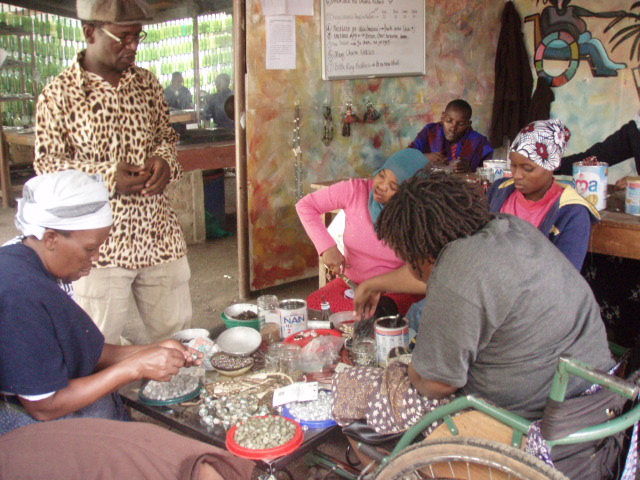
The next morning we went to Shanga, a cooperative for disabled people that teaches them to make crafts to sell, like beadwork, glass blowing, painting, sewing, weaving, etc.  Emmanuel also showed us the surrounding coffee plantation.  They have a nice restaurant on site where we had lunch before touring the facility.  We also had a lesson in Kiswahili sign language, since a lot of the people there are deaf.


Emmanuel shows us the coffee plantation

coffee beans

preparing an African lunch

beadwork

He can't walk but he can paint

glassblowing

A wall at Shanga

Beautiful beaded tile footpath at Shanga


On the way back to the hotel we stopped at a market so I could get a bag to store stuff and some socks.  I had thrown most of mine away because they were holey and washed my next to last pair in Moshi, where they still are since I forgot to take them down from where they were drying before I left.


Sunday, December 11, 2011

COFFEE, ANYONE?

On Friday, 12/9 I left Victoria Falls and flew to Johannesburg.  Again I was surprised to get lunch on the one hour flight. I got to the airport and there were signs all over to welcome people to the international climate change conference.  

 I had been trying to book a ticket since Tuesday on the Precision Air flight out at 11:30 that night, to Dar es Salaam and Arusha,  but the computer said the third party payment system was down and nobody answered when I tried to call the office.  I finally emailed and was told they would take care of me at the ticket office.  At the airport, I tried to book a ticket for Kilimanjaro that night on Precision Air, but was told by a rather rude man that the ticket would be 6,660 and there were no seats available until the next Thursday.  I went to other airlines and found no seats for the weekend.  British Airways had a seat on Monday at $1480.  Discouraged, I went online at a restaurant and ordered a ticket for the flight I wanted for $855 (not $560 as it had been earlier that week online) one way to Arusha for Monday on Precision Air.  I went back to the Precision Air desk to pay for the ticket, which had to be done within 24 hours.  She told me the online payment system was not working because when they started the new system last week, they had $100,000 in fraud, so the whole thing was shut down.  I also found out that the ticket was 6,660 RAND, the equivalent of $855, and had to be paid in cash, in rand.  I had had no dollars for quite awhile, and stocked up at the ATM in Victoria Falls since dollars were the official currency in Zimbabwe.  So I went and changed $600 into rands and got more rands from the ATM at the airport to pay for the ticket.  I held back $100 in cash, but that is basically all I have, except for a few Tanzanian shillings and about $20 in Rwanda currency that they would not exchange in South Africa or Tanzania.  The good news is that she was able to get me on the flight that night.  I had all my luggage with me and saved paying for a hotel in Johannesburg.

The flight left at 11:30 that night.  We had dinner around 1 a.m. then I tried to unsuccessfully to sleep until we landed in Dar at 3:30.  Everyone had to get their luggage and go through customs.  It was then an hour and a half flight on a propellor jet to Kilimanjaro airport, which is between Arusha and Moshi.  I took a bus to Moshi, the city closest to Mt. Kilimanjaro, planning to stay there for a few days before going to Arusha to meet up with my safari on Tuesday.  I got off the bus near the town center and went to the nearest hotel.  It didn't have private bathrooms, so I went down the street and found the Harambo Hotel with room and private bath for $25.  This is very basic accommodation, very unlike the luxury I had in Victoria Falls. No internet.  It is only 800 feet elevation here and quite a bit hotter, but I have a fan instead of air conditioning.  There is no hot water or sink stopper, so not good for washing the clothes I have been wearing nonstop for two days of traveling.   I went to sleep for a couple of hours then wore the same clothes out to see the town, figuring to start out clean the next day.

I wandered a bit around Moshi with the first objective of getting some money accomplished at the second ATM I tried (KNB).  I went to a travel agency and booked a coffee plantation tour for the next day to keep me from sitting around my hot hotel room.  My second main objective was to eat, and I had fish and chips and beer at a hotel with air conditioning.  Expensive at about $10, but at least I cooled off.  I met several shills on the streets and went with one to see his curio shop, but did not buy anything.  After that I went back to my hotel room and took another nap.  I went out later only to go to my hotel restaurant to get some bottled water, since I was dying of thirst by then and you cannot drink the tap water here.  She charged me a mzungo price of 3000 shillings for a large bottle and 1200 for a small bottle, which are 1000 and 500 in Ngara.  But I needed the water so paid the price.

The next morning I had the included breakfast at the hotel, which consisted of instant coffee, bread, watermelon and cantaloupe, not the huge buffets I was spoiled with for the past week in Zimbabwe.  My driver for the coffee tour, Eddie,  picked me up in a Landrover around 9:15.  He is a very nice young man who was raised in Arusha by his Chagga father and Masai mother.  He finished secondary education there and went to six months at a wildlife school so that he could be a safari guide.  He started out as a a porter and then a climbing guide and has climbed Mt Kilimanjaro 50 times.  He says every time is different because the clients are different.   

Eddie shows me a coffee plant


We drove about 45 minutes on mostly dirt roads to the coffee cooperative.  The land here is all owned by small farmers from the Chagga tribe.  The farms are as little as 1/4 acre in size.  They sell the dried coffee beans to the fair trade cooperative, which then removes the husks and roasts the coffee beans to prepare for sale.  I met our guide at the plantation, Dennis, an older man who owns a one acre farm but volunteers as a guide to help bring tourism money into the community.  We started out with a cup of the local coffee, then hiked around the area.  They have a kind of demonstration area in a covered patio where he explained the coffee growing process.  He showed me how they start the seeds in a small plastic bag and keep the soil wet for 30 days till it germinates, then planted after about 90 days.  They are planted 10 feet apart and may have bananas or some other crop in between.  The first beans come after about 3 years, and a full crop after about 6 years.  The bushes can last indefinitely but need to be pruned.

Dennis selecting beans to pick


We went out and picked some ripe coffee beans, which are red in color.  Then we put them in a hand turned machine with water to remove the skin.  They are then soaked for 24 hours to remove the oil before being put on a drying rack.  After this they are ready for sale.  We continued with the process the farmer would do to prepare beans for his personal use by grinding the beans in a big mortar and pestle to remove the hard husks, then putting them in a flat basket to separate the husks from the beans by bouncing them and blowing the lighter husk material off.  We then roasted the beans in half of a clay pot over an open fire.  They turn dark in color as they cook.  Back to the mortar and pestle to grind the beans to powder, then they are sifted through a wire mesh to remove any pieces of husk left.  We then boiled the ground coffee before sifting it into a thermos to remove the coffee grounds.  Finally, we got to drink the coffee, which was pretty strong.


remove the skin

soak 24 hours then dry

roast


grind then sift

boil

drink!


After walking back to the reception area, my guide, driver and I  got a lunch of banana soup, rice, beef stew, vegetable stew, cooked bananas, and a tomato and cucumber salad.  There was one other tourist there, a Japanese woman who was just finishing lunch with her crew when I came.  They had apparently had a group of tourists overnight, and were taking down the tents they had used.  The overnight tourists get the coffee tour the first day and then a choice of nature, traditional medicine, or  Chagga village walk the next day.   I had told my guide, Dennis, that I was a nurse so he showed me a lot of the plants used for swelling, bleeding, emetics, congestion, etc as we passed them.   He also showed me how they twist leaves in different shapes to give messages, like "banana beer for sale at this house."

By next year, the plan is to have a paved road all the way there.  Both the currency and coffee prices fluctuate, so they have been looking at tourism as a way to bring in a more stable income and provide some jobs for the community.


Wednesday, December 7, 2011

CANOEING WITH THE HIPPOS


I decided against whitewater rafting because you had to go up and down a huge mountain of steps with no handrails to get to the river, which would be difficult for me normally, and more so because my recent health issues have made my sense of balance worse and I am more prone to falls.

Instead I went canoeing this afternoon on the Zambezi River between Zimbabwe and Zambia.  There were national parks on both sides so it was complete wilderness except for a few isolated resorts along the shores.  My companions were an Australian couple, Sam and Deb, and their three daughters, Rachel, Miriam, and Lizzie, ages about 8 to 18.  Their fourth daughter is studying in France. We had two people to a canoe, and I shared with Obit, one of the two guides.

Getting ready to canoe
the Australians


Obit shared the canoe with me


There are lots of islands in the river, so we were actually in Zambia part of the time.  There were a few sections with small rapids and some whirlpools, which just made the canoes spin a bit.  Of course you get wet canoeing, but the water was wonderfully warm.  When I get on my homepage, I read that the temperature in Asheville has been in the 20's lately and it does not seem real here in the Southern Hemisphere.  It is much hotter here than it was in Ngara or Kigali, ranging from 75 to 85 degrees.

We saw lots of hippos, who are supposed to be the most dangerous animal in the water in Africa and kill many people every year.  Our guide seemed to know which groups had baby hippos, which would be especially dangerous to go near.  At one point one of the hippos opened his huge mouth wide and showed all his teeth, which Obit told me was a sign of agression.  They usually just stand in the water with their eyes and ears showing, but this one came after us.  He was getting nearer but luckily we came to a set of rapids and left him behind.  


Elephants on shore


In the evening, I went to the Boma Restaurant at the Safari Hotel.  A driver picked me up, as well as a Spanish couple staying at the Victoria Falls Hotel who spoke no English.  He needed me to translate since the husband did not come down right away and he could not understand why.  They have a great buffet with lots of wild game, both grilled and in salads.  They also had dancers and singers.  They gave us drums and we all had a great drumming session that he directed.  Later I danced. 


Tuesday, December 6, 2011

WALKING WITH THE LIONS

Morris, the Jamaican Canadian I met on the Chobe trip, had been a volunteer for several weeks at the Lion Walk, an NGO that is helping to reintroduce lions into the National Parks in Africa.  Studies show that the lion population in Africa has dropped 80-90% in the last 30 years, from 200,000 to as low as 16,000.  At this rate, there will soon be no lions left outside of zoos.  

Guard, Israeli volunteers, and Morris observe the cats


They raise lions and accustom them to people, so they can raise money for the project by having tourists walk with the lions.  They are well fed and kept from harm, but they don't discourage their instinctive hunting behaviors.  At age two, the lions are sent to another reserve where they are still watched and fed when needed, but left more on there own with no unecessary human interaction.  Their cubs are totally wild, and are sent to various game reserves in Africa to repopulate.  There are only a few lions in the project at a time, so it is a slow process.  

We all carry long sticks.  If the lion gets aggressive in any way, you either tap him on the snout or put it between his teeth to distract him.  We walked for about half a mile with the lions.


Monday, December 5, 2011

CHOBE NATIONAL PARK

On Monday, I was picked up at the hotel and I and Morris, a Jamaican who lives in Dawson Creek, Canada were taken in a bus to the Zimbabwean border, where we were picked up by a tour guide in a Landrover on the Botswana side and taken to the Chobe Marina Lodge on the Chobe River between Botswana and Namibia.  We cruised in a boat down the river all morning and saw many more animals and birds than I had on the Zambezi River, including vervet monkeys, open billed storks, monitor lizards, lechus (like an impala), fish eagles, kingfishers, Nile crocodiles, hippos, cape buffalos, kettle egrets, African spoonbills, great white egret, longtailed plover, gray herons, elephants, and water bucks.


Chobe Marina Lodge boats
Looking into the crocodile's mouth

hippos

cape buffalo

elephants


We had a nice buffet lunch on returning to the lodge, and I tried the local beer.  We then drove to the Sedudu entrance of Chobe National Park for a game drive.  The park is 11.7 square km and is not fenced so the animals wander in and out.  The first animals we saw were impalas, which our guide called "the McDonalds of the wilderness" or "fast food for the lions."  In addition, we saw wart hogs, Marabou storks, buffalo, tortoises, many elephants, baboons, guinea fowl with bright blue heads, mongeese, and kudus.  One of my favorite things to watch was the dung beetle, who rolled a ball of dung bigger than he was along the dirt.  I was told he (she?) puts the ball in a hole and the female lays eggs, which get nutrients from the dung ball.  We didn't see giraffes or zebras in the park, but they were on the road to and from the border.


impalas

warthog

Marabou stork

elephant

baboon
our safari vehicle
guinea fowl
mongeese
kudu

elephants seeking shade