Saturday, May 26, 2012

TO LOS ANGELES


It was very bittersweet to leave Africa.  My last day was May 14, and I spent some time standing on my balcony at Elephant Hills looking down at the huge lawn and the herd of impala grazing there.  In the distance I could see the Zambezi River and the huge clouds of mist from Victoria Falls.  The air was very fresh with a faint chill left from the night, but the sun was shining and the sky a beautiful blue.

I took a taxi to the airport and boarded a British Airways jet to Johannesburg.  I had to wait 3-4 hours for the plane to London and used the time getting last minute gifts and using up my remaining South African rand.  Then I had an 11 hour flight to London and another 11 hour flight to Los Angeles.  So I was quite done in when I reached LA, and was happy to see my brothers David and Alan there to pick me up.  I was not so pleased that the customs officer confiscated the $15 worth of kudu biltong (like jerky) I had bought at the Johannesburg airport for my brothers.

I stayed a few days in Santa Monica at the family home and used the time shopping for some new clothes, since I had donated a lot of mine in Africa.  On Saturday my friend Laurie picked me up and took me to her house in Westminster.  Then followed many lunches and dinners to get together with old friends.  I bought a new camera to replace the one I gave to the the lion caretaker at Chipingali.

Book Club friends (from front right) Sandra, Karen, Laurie, me, and Emmy

Sunday, May 13, 2012

CHIPINGALI week two


We have had several new animals in the time I have been here.  We have two kittens and 4 black bunny rabbits, all found on the property with no mom in sight.  It is difficult to get the bunnies to take milk from a syringe, but they seem to be doing OK.  

A few days ago a man on a bicycle brought a baby steenbok (small antelope) in his backpack.  We put it in a cardboard box with grass to keep it warm and fed it milk, but it died that night.  They tell us that antelopes get very anxious and like to hide, so they often die before they get used to humans.  We have another small antelope, a duiker, who has been here a few weeks already.  They thought he would die, but he is getting more used to humans and not hiding in the covered part of his cage so much.  He will now even take food from my hand sometimes.

We have had two new baby goats.  The first was premature, I think, because the second one was born a few days later and was three times the size of the first one.  The first one had difficulty eating in the beginning, but has come through that OK and the kids are now about the same size.


Nicole with baby goat #1

Baby goat #2 born 3 days later

Baby baboons


Baby bunny rabbit

Baby kitten

There is also a baby leopard and three lion cubs, but I am not feeding them!  Their mothers are taking care of them fine.

The chores are many and varied.  We had to rake up dried grass that had been previously cut into piles.  They grass was put in a truck and is now in a covered area.   I have to go there to get new grass to put on the floors of the monkey and lion cages.  One day three of us went to the "game park" part of the property, which is wild but fenced in, to search for snares put up by people trying to catch our wild animals.  We went through a lot of high grass, and Arnaug and Jackie both had several ticks on them.  He got bitten, but I came away untouched, at least as far as I know.  I don't think they have lyme disease here, but there is tick bite fever, which Nicky has had and says gives you horrible headaches.  Another day we made chain link fence, which I didn't know was possible to do by hand.

Making chain link fence


Nicky surprised me by taking me to the local primary school for a tour.  They just started buying baby chicks and raising them to sell to get money for the school.  We went back the next day so I could donate a couple of boxes of pens and to have one of the Chipangali workers cut down some Eucalyptus trees so the parents could make a new jungle gym.


We have visitors for the weekend:  two of the trustees are Finnish but live in Harare and run an orphanage for children whose parents died of AIDS.  They brought two young Finnish volunteers and five orphans.  So now we have about 20 people for meals, but it seems to be working out.  The kids loved seeing the animals, but are afraid of the kittens and won't hold them.  I have seen that reaction in other African children.  Pets don't seem to be common here.  Cats are to catch rats, period.


Visitors from Finland and Harare


Christine from Holland and friend


Monday, May 7, 2012

CHIPINGALI


Nicky Wilson picked me up two hours late because of a late start and  trouble finding the house.  We stopped at the Indian vegetable store before heading out to Chipangali, the wildlife orphanage that sits on about 200 acres 20 km outside of Bulawayo.  I got a tour of the facility and met Nicole, the volunteer coordinator, and the other volunteers:  Mikhail from Norway, Chris and Xander from Holland, Armaug from Israel, and Jackie from Australia.  They are all 18-24 except for Jackie, who is a 42 year old nurse who alternates working and volunteering in Asia and Africa.


Nicole and Nicky


Jackie the volunteer

Jackie the jackal


Our accomodations are in "the Camp," which has 6 cabins, a kitchen and dining area, a toilet and shower block, and a lawn area with a barbeque, swimming pool, and a firepit 6 feet in diameter.  They are in the process of rebuilding the cabins, and the new ones are brick on a concrete slab with thatched roofs and ensuite bathrooms.  Currently they have only one done and one in process, but they are supposed to be finished by December (TIA?).  I have no windows in my cabin, but the metal roof is supported by logs and is open on both sides between the walls and roof.  I do get spiders and rats at night, so I got a mosquito net so I can feel more secure when I sleep.  I haven't heard any rats since I got rid of the
food I had with me.


My room at Chipangali


Volunteer cabins

Peacocks roam the grounds

We have breakfast in the Camp kitchen,  mainly toast and coffee or tea, but there is a refrigerator with eggs and syrup, so I did get ambitious and made French toast on the hot plate on my day off.  We work six days a week and have to be at roll call at 7:45 a.m., so toast is enough effort most days.  I am usually the first one up and heat the hot water.  There are always a lot of bugs (mostly ants) I have to clean out of the pot first since they are attracted to the water left in there overnight

At roll call, the African workers get their assignments for the day first, then Nicole decides what to do with the volunteers.  This is Jackie's second time here and she has been here a few months, so she is in charge of feeding and cleaning the cages of the carnivores (lions, cheetahs, hyenas, leopards, jackals, mongoose).  She usually takes one volunteer to help, plus they have an African worker.  The rest of us usually start by cutting large, leafy branches from various areas on the property with machetes and dragging them to the antelopes and goats for feeding.  They have to eat 20% of their body weight each day.  Then we do whatever needs done, like cleaning cages or just playing with the animals, especially the ones who are in cages by themselves.   A lot of the animals are orphans or injured in some way, like being bit by a lion or hit by a car.  We have birds with only one wing and a blind monkey.  There is also a warthog, cows, sheep, and goats.


Workers wait for assignments at roll call

Cutting branches for animal food

It is expensive to keep 25 lions and 3 leopards in meat.  A lot of the "food" is donated by local farmers when animals die.  In the first week I was here, they got calls to pick up two donkeys, five cows, a horse, and numerous chickens.  They have a large refrigerator to store the meat.  I try to avoid the area where they cut the things up, since dead animals can be quite odiferous and attract a lot of flies.


The orphanage was founded by Vivian Wilson, a former park ranger and head of the Natural History Museum in Bulawayo, in 1973.  He has published several books, and I am reading Orphans of the Wild, which was made into a TV series in the 1970's.  He is 80 years old now and lives in town.  His son, Kevin, and wife Nicky, and their children Michaela and Ryan now live in the house here and manage the property.  We go to the house to eat lunch and dinner on their patio.  It is usually prepared by their maid, Patricia.

Vivian (called VJ) has been sick and in the hospital lately.  Someone called the SPCA and said his animals had no water.  He has several house staff who take care of his animals, but we feared they had been slacking off since he wasn't around.  Nicole took the volunteers to his house to clean up his bird pond and huge aviary before the SPCA inspectors came the next day.  We did not have to deal with the snakes.  

At Chipangali, we have several monkey cages, aviaries, turtle and crocodile environments, and a snake house.  There is a black mamba that is about six feet long.  These are the most dangerous snakes in Africa, since they do not run away, but are more likely to chase you.  Their venom is both neurotoxic and cytotoxic, so it affects the nervous system and body tissue.  There are also pythons, puff adders, and a cobra.


One of the aviaries

Tammy the kudu

Black mamba snake

Crocodile


A highlight of the week was the soccer match of the Chipangali team versus a team from a Bulawayo church.  We lost, but had a great time.


The Chipangali soccer team


Saturday, April 28, 2012

BULAWAYO


I reached Bulawayo on 4/26 and was taken up by Noma and "Z" from Silvane tours.  I was pretty sure, but not positive, that Tandy from their sister office in Victoria Falls had made my room reservation at Cresta Hotel while I was sitting there, but Noma said that when she called they had no rooms.  She said she also called twenty other places, so they were going to take me to their co-worker's house to see if I liked her spare room, or else we would look for another lodge.

I went to meet Christine and her fiancee Richard at their home in the Northend suburb.  The room was fine, but I did not fancy her having to take me on when she is on vacation this week, since that seemed very intrusive.  We went to another lodge that had told Noma they had a vacancy, but they had booked the room.  It is the annual Trade Fair week, so rooms are extremely scarce.  We drove around and investigated a few other lodges.  One in the industrial area had a room up three flights of stairs with a shared bath, which I declined.  We kept finding "no vacancies" till we found another in the Ilanga suburb that had a decent room with shared bath down the hall for $130.  That seemed a rip off since the best hotel in town had quoted me $105, even though they "lost" my reservation.  It is apparently the practice here to jack the prices way up for Trade Fair week.  It must work, since there are almost no rooms left in the whole town and the Fair did not officially open until the next day.  My last option was a room at Z's house.  He is a bachelor and does not cook, and the house was a little messy, though the huge yard is beautifully kept up by the gardener.

After two hours of driving around, I decided to go to Christine's.  We made a detour to the Trade Fair, which was having a preview day before President Mugabe comes for the official opening.  The place was packed, with exhibitors from all over the world, including Ford autos.  It was kind of like a county fair, with permanent exhibition buildings, livestock, agricultural exhibits, music, dancing, and food.  We walked around, but I was a lttle tired at this point and not too much I was interested in.  It reenforced my feeling that, despite what we hear about it being next to last on the list of "failed nation/states," Zimbabwe is doing well.  Downtown was busy, with few empty storefronts, lots of people walking around, and no clunker cars in sight.  In our search for a room, I saw many nice, orderly suburbs.  I rarely saw white people apart from at the Trade Fair.

Christine in front of her sister's house
Christine and Richard are very nice and welcomed me to their home.  She apparently has no money and no food in the house, since "payday is far off."  Z took me to the supermarket and I bought salad and bread for dinner and Christine made some chicken.  There was no butter, milk, or salad dressing in the house.  Then I discovered that Christine and Richard live elsewhere in a room they rent for $135 a month and they are house sitting for her sister, who is currently in South Africa and getting ready to move to Wales with her new husband, who she lived with five years ago before he disappeared when she was six months pregnant.  I am sleeping in the sister's bed, and hopefully she will not be back before I leave, although she may show up tomorrow, along with her two kids.  The new husband is already back in Wales and she is trying to get them all visas to join him.  Christine, Richard and I stayed up late talking about Zimbabwe and the life here.  They were born before independence and consider themselves white Rhodesians.  They had some horrific stories about violence and corruption in the country.  A few years ago the markets had no food and you could not buy anything.  Inflation was so bad that millions of Zimbabwe dollars would not buy you a loaf of bread.  You were not allowed to take money out of the bank, and many people were forced off their properties with no notice so ended up leaving the country with only the clothes on their back.  Christine works full time and gets the standard wage of $200 a month.  Richard is currently an unemployed miner, but has made as much as $1000 a month in the Congo.  He is unable to get a passport, though, since they say he is not Zimbabwean since his grandfather was English.

Christine's daughter has an African father with AIDS


Z and Noma picked me up the next morning, along with Shah Shah, an experienced guide who is also a second year law student.  Noma apparently had been working in the butcher shop next to the travel agency until the week before and I am her first client.  Christine trained her and has been advising her even though she is on vacation.  Z is the owner's brother and has his fingers in other pies besides driving for tours.  The owner works for the UN and is currently in Sudan.  Tandy in the Victoria Falls office also came from the butcher shop and just moved up there a week ago.  So I am kind of a test client for all these people.  The hotel room was a major mix up, but they seem to be bending over backwards to make up for it.  My one day tour is stretching into three.

We are going to Matopos National Park today, where they have Bushman cave paintings and Cecil Rhode's grave.  They made some mistakes in picking me up half hour after the agreed on time,and stopping to get diesel, food and drinks after they picked me up, so we had a late start for Matopos.  It is about a 45 minute drive from Bulawayo.  

The first stop in Matopos was the Memorial for the Tin Heads (MOTH), which is apparently an international organization that maintains graves for soldiers from WWI and WWII.  The ashes of several soldiers were brought here when it was established in 1927, then the WWII victims were placed here in 1947.
MOTH WWII memorial

Shah Shah in front of MOTH


Cave painting
Next we visited the White Rhino Cave.  It was kind of a difficult climb up for me, since I had to scramble over some rocks, but would be no problem for a younger person in normal shape.  There is a huge rock cave with pictures of animals and men.  Shah Shah says the paint is a mixture of blood and an unknown plant.  After we climbed back down, I saw a cobra about two feet from me.  Luckily it was a youngster and quickly moved away.

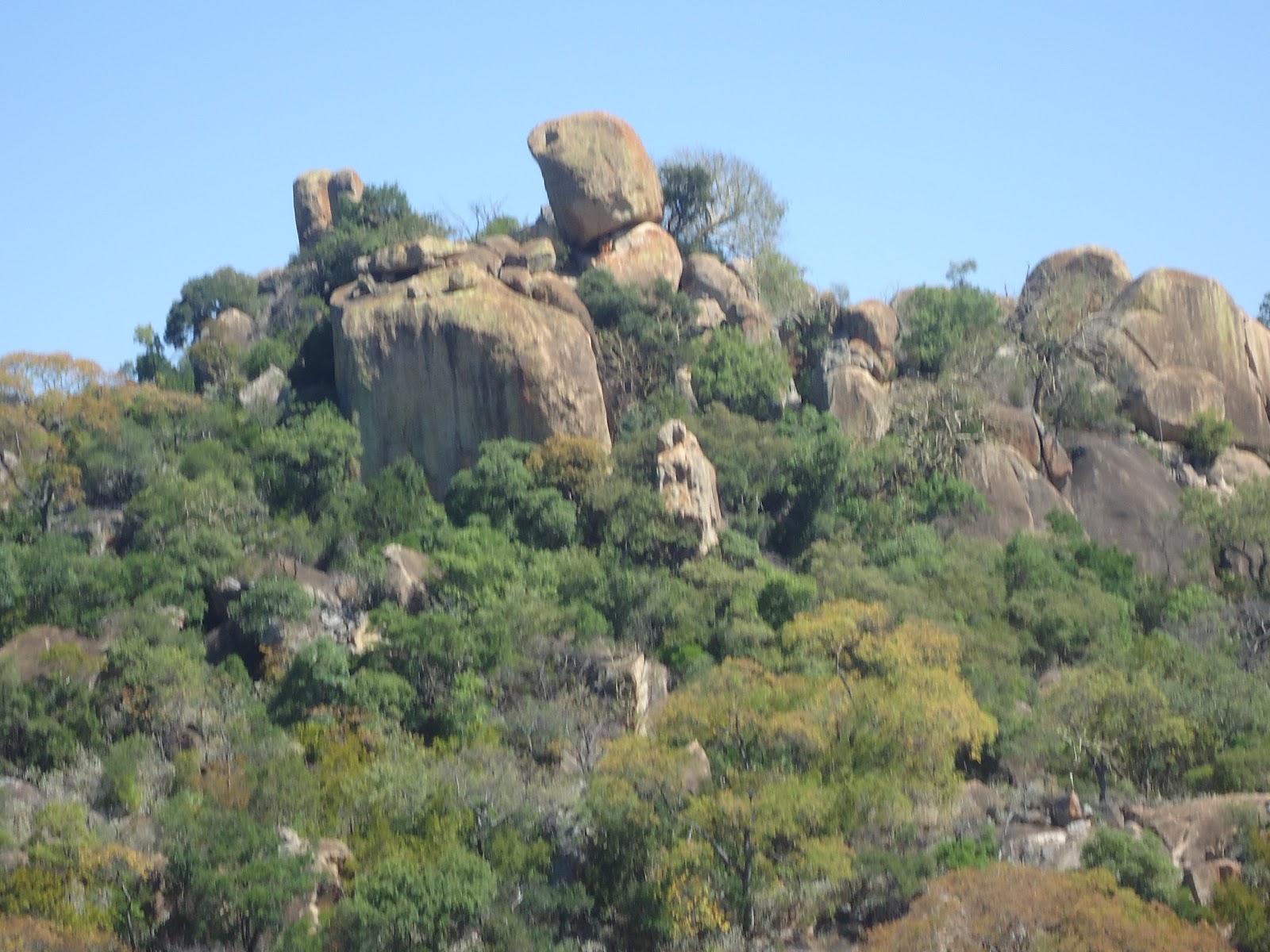
Matopos National Park is known for its rock formation

Next we drove past many interesting rock formations to the "top of the world" hill that holds the graves of Cecil Rhodes, some of his friends, and soldiers that were killed in a skirmish nearby.  The 360 degree view is extremely impressive, since you just see all the interesting rock formations all around and no manmade structures except for the road as far as you can see.  This was part of Cecil Rhodes" South African empire, besides the Kimberly and De Beers diamond and gold mines.  He actually died in South Africa in 1902, but his will stated that he wanted to be buried here so he came in state after being seen off by a huge crowd in South Africa.  Our guide says the area is rumored to hold the legendary King Solomon's mines, which probably is what drew old Cecil here.


Noma, Shah Shah, and Z


Cecil Rhodes' grave

Rocks have colorful fungi
Memorial to fallen soldiers


We had lunch at Mekele Dam, a picnic area with a small lake.  Noma had purchased roast chicken, rolls and fruit, which was perfect.  The only problem was many small flies that seemed to like me and were getting into my eyes and ears, though they didn't seem to bother the Africans much.

Mekele Dam picnic site
After lunch we went to the Pamongwe museum and cave.  This was much bigger than the first one and almost a half round like a bowl.  The cave paintings were faded but you could still make some out.


Our next stop was the Natural History Musem in Bulawayo.  The first floor had a lot of very bad (or very old) taxidermy showing different African animals.  Upstairs was more focused on history and entomology.  Some of the exhibits were empty, like the African gold artifacts.  A lot of the lights didn't work so some exhibits were hard to see.

I had stated that I had not seen any poor Zimbabweans, when that is all we hear about.  They drove me through the township, where the white people's domestic workers and such used to live.  It is still a thriving community and much more like what I think of as Africa, with outdoor stalls, rutted roads, small and block houses.   Not as bad as the townships in South Africa though, and there were a lot of satellite dishes around.

Back to Christine's for more chicken and salad.  Kevin from Chipangali called and will pick me up in the morning.

Friday, April 27, 2012

VICTORIA FALLS


Our tour ends in Victoria Falls, my fourth time here.  This has always been my favorite place in Africa, and I thought Okavango supplanted it, but seeing the falls at peak flow with several rainbows along the length has put it firmly back on top.  I had my umbrella but still got totally soaked walking on the path above the falls, as the spray is incredible and at places you can't see in front of you because the mist is so heavy.  It was a beautiful sunny day, unlike the gray day I had here in December.  I had my lunch with me in a baggie and planned to find a nice spot to sit and eat it.  Everyone else had already eaten theirs since they missed breakfast due to the early game drive.  I was walking past some baboons and one made to grab it.  I batted him with my closed umbrella and he ran away.  Then some others on the path were eyeing it but I stared them down and they walked away.  Finally one big bruiser just came up and grabbed it.  He sat as high as my waist and had very long arms so I just let the bag go, as I knew not to mess with him or he would use his big teeth on me.  Some of the Germans who were walking with me took pity on me and gave me a sandwich and an apple.


For our farewell dinner that night, we went to A Zambezi resort.  They had a nice buffet, including grilled warthog, which sounds awful but was actually a lot more tender and flavorful than the grilled beef and chicken they had.  For entertainment, they had an African marimba band.  Several men played xylophones, drums, and marimbas.  Most of the songs sounded African, but they did play Guantanamera.  After that, they had some male African dancers, who were quite good.

I elected to stay two extra nights at Elephant Hills resort.  The second day I went on an elephant safari through the bush.  We were six  tourists plus handlers on three elephants.  It was hard for me to get on and off, and when we went downhill and I had to lean back, very hard on the hip joints.  I survived.


View from my room at Elephant Hills


View from Victoria Falls Hotel


The third day I took a shuttle into town to see about the train to Bulawayo.  Air Zimbabwe has an office but confirmed they are not flying.  The office is apparently open just to give the information that they aren't operating, but they haven't been for at least a year.  When I looked online, the airfare to Bulawayo was $1200.  It is only a five hour drive, but you can't fly there directly, only from Johannesburg.  The train takes 12 hours (or more), but I really like trains so I would like to try it, at least one way.  You have to book it the same day you travel, so I got there on the first shuttle at 9:45 and first class sleepers were already sold out.  I did not fancy sharing a second class sleeper with three others, plus they don't furnish bedding in second class.  I ended up making a bus reservation for the next day.

I had lunch at the Victoria Falls Hotel, the oldest hotel in Zimbabwe and always a treasure.  From the terrace restaurant I could see the mist from the falls and watch the bungee jumpers on the bridge.  I could hear one girl screaming, presumably as she fell.

I went into a travel office to investigate tours in Bulawayo, since I will be there an extra day before I have to get to Chipangali, the wildlife orphanage where I will volunteer next.  I booked a Friday tour of Matopos National Park.  They also arranged for me to stay at Cresta Hotel in Bulawayo for two nights.

The next afternoon I splurged and paid $130 for a helicopter ride over the falls.  I thought it was well worth the money.  It was a beautiful day and I saw several rainbows, sometimes two at once.

Since I am not overnighting on the train, I moved to the Kingdom Hotel for one night.  I got them to give me the internet rate of $175, but it is still $45 more than Elephant Hills.  It felt like coming home, though, after having spent a week there in December.  One reason I moved was to get better internet, and I never got it to work there.  So I am extremely late on my blogging.

After a rushed 7 a.m. breakfast, I got on the Pathfinder bus at 7:20.  The bus goes daily and I wasn't expecting much, since this is Africa.  It was very luxurious though.  There was a driver and a host, who wore a dress shirt, tie, and sweater vest.  At 8 a.m. he offered Cokes, and at 8:30 we got sandwiches (chicken salad or cheese and tomato).  Then he came by with bottled water.  We had a 5 minute rest stop at Hwange Safari Lodge in the National Park, and only two other brief stops to pick up people.  While I was on the bus, Noma from Silvane tours called me to find out when I was arriving, so when I got off the bus at 12:35 (25 minutes early), there she was holding a sign for "Mrs. Morris," so I felt well taken care of.